Dynamic Action: The Power of Paintball Game Vector Illustrations in Visual Storytelling
In the fast-paced world of digital marketing and graphic design, the ability to convey high-energy action instantly is crucial. Whether you are designing a landing page for an adventure park, creating a brochure for a corporate team-building event, or developing assets for a gaming website, the visual representation of your subject matter sets the tone immediately. One of the most effective ways to capture the thrill of competitive sports is through Paintball Game Illustration. Specifically, vector graphics depicting people playing paintball offer a unique blend of clarity, scalability, and artistic flair that raster images often struggle to match.
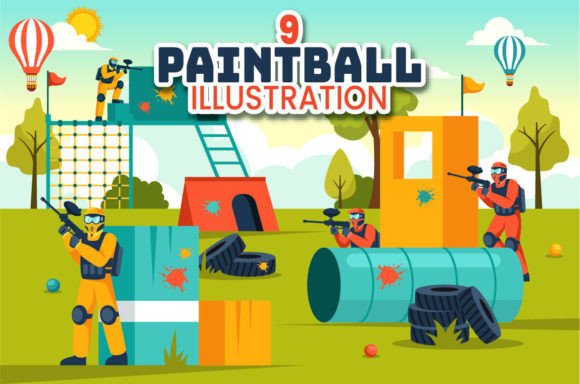
This article explores the significance of using high-quality vector illustrations of fighter players shooting, aiming, and attacking in field scenes. We will delve into why flat cartoon backgrounds are so popular, how these assets fit into modern business strategies, and the technical advantages of fully editable files like AI, EPS, SVG, and PSD formats.
The Appeal of Flat Cartoon Style in Sports Graphics
When designers choose a flat cartoon background for their projects, they are making a deliberate stylistic choice to prioritize clarity and engagement over photorealism. In the context of a paintball scene, this style strips away unnecessary details, focusing the viewer's attention on the core action: the player, the gun, and the target.
Flat design has become a cornerstone of modern web aesthetics. It loads faster than heavy photographic files, scales perfectly across all devices from mobile phones to large outdoor banners, and maintains its crispness at any size. A People Playing Paintball Vector Illustration rendered in this style communicates excitement without visual clutter. It allows the audience to instantly grasp the narrative—a player in full gear, crouching behind cover, aiming their marker with intense focus—without getting lost in complex textures or lighting effects.
Why Vector Art Matters for High-Energy Scenes
The primary advantage of using vector art for dynamic scenes like paintball battles lies in its mathematical foundation. Unlike pixel-based images (JPEGs or PNGs) that degrade when enlarged, vector graphics are defined by paths, lines, and curves. This means a small icon of a paintball player can be blown up to the size of a billboard without losing a single pixel of quality.
For businesses running multi-channel campaigns, this scalability is non-negotiable. You might need the same image of a fighter player shooting for a social media post, a printed flyer, and a massive trade show backdrop. With a fully editable vector file, you have one master asset that serves all these purposes flawlessly. Furthermore, the clean lines of vector art make it easier to overlay text, ensuring that your headlines and calls to action remain legible against the busy background of a game scene.
Practical Applications Across Industries
The versatility of a Paintball Game Illustration extends far beyond simple decoration. These assets serve as powerful communication tools across various sectors. Let's explore how different industries utilize these graphics to achieve their goals.
- Event Marketing and Tourism: Adventure parks and paintball fields use these illustrations to showcase the experience. A vibrant image of a player attacking in a field scene invites potential customers to imagine themselves in that role, driving ticket sales and bookings.
- Corporate Team Building: Companies organizing retreats often need to communicate the concept of "strategic fun." A professional yet energetic vector illustration helps sell the idea of teamwork and strategy to employees who might otherwise be hesitant about physical activities.
- Gaming and Esports: Even digital gaming communities benefit from stylized vector art. Developers and streamers use these assets for thumbnails, loading screens, and promotional banners to create a cohesive brand identity that resonates with gamers.
- Education and Safety Training: Believe it or not, these illustrations can be adapted for safety manuals. By simplifying the scene, instructors can highlight specific equipment usage, such as proper mask fitting or safe handling of markers, without the distraction of realistic violence.
Technical Excellence: Understanding File Formats and Editability
One of the most critical aspects of acquiring professional-grade design assets is understanding the file formats provided. A high-quality package for a paintball illustration typically includes a suite of formats designed to maximize flexibility for the end user. Let's break down what each format offers and why it matters for your workflow.
The Core Vector Formats: AI, EPS, and SVG
The backbone of any vector project is the source file. Most professional packages include AI (Adobe Illustrator) and EPS 10 files. These are industry standards that allow designers to manipulate every element of the illustration. If you need to change the color of a player's jersey to match your brand guidelines, or adjust the angle of the gun slightly, these formats make it easy to edit the object without starting from scratch.
Additionally, the inclusion of SVG (Scalable Vector Graphics) is essential for web developers. SVG files are code-based, meaning they can be embedded directly into HTML pages. They are incredibly lightweight, which improves page load times, and they can be manipulated using CSS and JavaScript. For a landing page featuring a fighter player shooting, an SVG ensures the animation remains smooth and responsive on any screen size.
Raster Options: PSD and PNG
While vectors are king for editing, sometimes you need a quick solution for a layout that doesn't require deep customization. This is where the PNG transparent background comes into play. A PNG allows you to drop the illustration onto any colored background or photograph without the unsightly white box that often accompanies JPEGs. The transparency ensures seamless integration into existing designs.
Furthermore, the inclusion of a Psd Photoshop non grouped unlabeled file adds another layer of utility. While not a vector, a layered PSD allows for advanced photo manipulation. Designers can apply filters, blending modes, and texture overlays to give the flat illustration a more painterly or gritty look if the project demands it. The fact that the layers are ungrouped and unlabeled (or simply organized logically) means you can navigate the file structure quickly, finding the specific elements you need to tweak.
Common Misconceptions About Vector Illustrations
Despite their widespread use, there are several misunderstandings regarding vector art that can hinder beginners from utilizing them effectively.
Misconception 1: Vectors Look "Cheap" or "Childish."
Many assume that because vector art uses flat colors, it lacks sophistication. However, modern vector techniques involve subtle gradients, shadows, and depth cues that create a highly polished, professional look. A well-executed paintball game illustration can look just as premium as a photograph, often conveying more emotion through stylization.
Misconception 2: Editing Requires Advanced Skills.
While mastering Adobe Illustrator takes time, basic edits to a vector file are surprisingly accessible. Changing a color palette, moving an object, or swapping a background is often as simple as clicking and dragging. The "easy to edit" feature mentioned in professional asset descriptions is genuine; these files are built to be modified by users with varying levels of expertise.
Misconception 3: One Size Fits All.
Some believe a single vector file is static. In reality, because these files are composed of distinct layers and objects, they are infinitely adaptable. You can extract just the gun, just the player, or just the background foliage to create entirely new compositions. This modularity makes them a cost-effective investment for long-term branding.
Building a Cohesive Brand Identity with Custom Assets
In today's crowded digital landscape, standing out requires more than just good copy; it requires strong visual identity. Using custom or highly adaptable vector illustrations allows businesses to maintain consistency across all touchpoints. When you have a library of assets like a People Playing Paintball Vector Illustration, you can ensure that your posters, web banners, brochures, and landing pages all speak the same visual language.
Consider a scenario where a paintball facility wants to launch a new "Night Ops" campaign. Instead of commissioning a costly photoshoot, a designer can take the base vector illustration, darken the sky, add neon accents to the gear, and adjust the lighting effects within the PSD or AI file. The result is a fresh, campaign-specific asset that aligns perfectly with the brand's existing style guide, created in a fraction of the time.
The Future of Visual Communication
As technology evolves, the demand for versatile, high-quality digital assets continues to grow. The shift towards mobile-first design and interactive web experiences means that scalable, lightweight graphics are more important than ever. Vector illustrations of action sports like paintball are not just decorative; they are functional tools that bridge the gap between imagination and reality.
By leveraging the power of Fully editable vector files, including AI, EPS, SVG, and layered PSDs, creators can produce content that is both beautiful and practical. Whether you are a seasoned graphic designer or a business owner looking to upgrade your marketing materials, understanding the value of these resources is the first step toward creating compelling visual stories.
Ultimately, the goal is to engage the audience. A dynamic image of a player aiming and attacking in a field scene captures the essence of competition and fun. When executed correctly with the right tools and formats, these illustrations become the heartbeat of your visual communication strategy, driving interest, clicks, and conversions in an increasingly visual world.