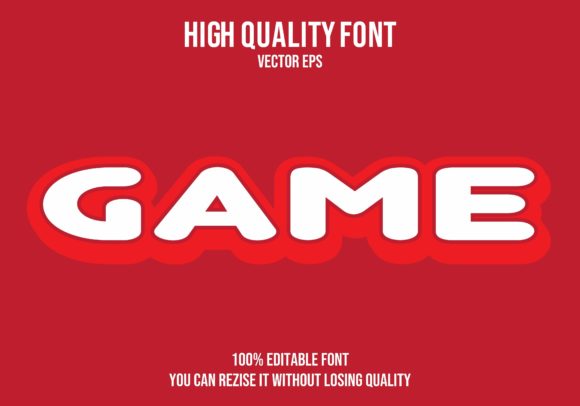
Game Vector Text Effect Fully Editable: A Practical Evaluation for Designers
In the competitive landscape of digital design, particularly within gaming and entertainment sectors, typography often serves as the primary vehicle for conveying tone, energy, and brand identity. The Game Vector Text Effect Fully Editable resource represents a specific category of design assets that aim to streamline this process. For professionals aged 20 to 50 who are tasked with creating high-impact visuals, understanding the utility, limitations, and comparative value of such assets is essential. This article explores the technical capabilities of this text effect, evaluates its place within a broader workflow, and provides a balanced perspective on when it serves as an efficient solution versus when custom creation might be preferable.
Understanding the Core Utility of Vector Text Effects
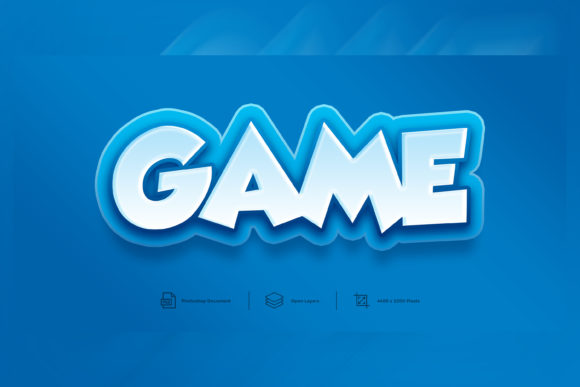
The fundamental appeal of a Game Vector Text Effect Fully Editable lies in its format. Unlike raster-based images (such as PNGs or JPGs) which degrade when scaled, vector graphics maintain crisp edges at any resolution. This distinction is critical for modern design projects where assets must appear on everything from small mobile screens to massive billboard displays. When a designer selects a fully editable vector file, they are choosing flexibility over static convenience.
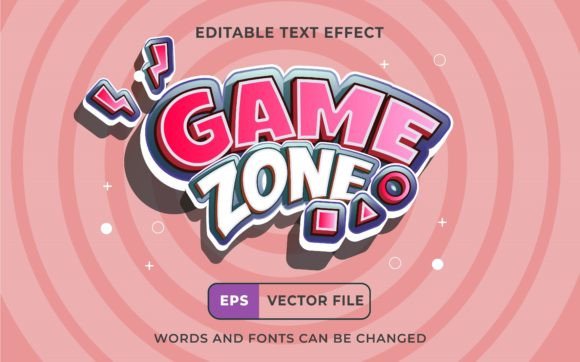
This specific resource is typically delivered as an EPS source file, a standard format compatible with industry-leading software like Adobe Illustrator. The "fully editable" claim implies that the underlying geometry of the letters can be manipulated without losing quality. Users can alter the font, change the color palette, adjust the depth of shadows, or modify the geometric shapes that create the "game" aesthetic. Furthermore, the ability to easily reduce or enlarge size ensures that the asset remains versatile throughout the production lifecycle, from initial mockups to final print-ready outputs.
Comparing Pre-Made Assets vs. Custom Creation
When evaluating design resources, the primary decision point often revolves around time efficiency versus unique customization. Creating a complex 3D-style game text effect from scratch requires significant proficiency in tools like Illustrator, including mastery of effects panels, gradient meshes, and layer manipulation. While this approach yields a completely unique result, it is time-intensive.
In contrast, the Game Vector Text Effect Fully Editable offers a middle ground. It provides a sophisticated starting point that has already undergone the laborious process of constructing lighting, texture, and dimensional effects. Compared to hiring a freelance illustrator for a one-off logo, purchasing or downloading a pre-made vector pack is significantly more cost-effective. However, compared to a simple system font, it offers far greater visual impact. The tradeoff is that while the structure is editable, the foundational style remains rooted in the original creator's vision. If a project requires a radically different structural approach than what the template provides, the time spent modifying the existing layers may approach the time required to build something new.
Evaluation of Editability and Layer Management
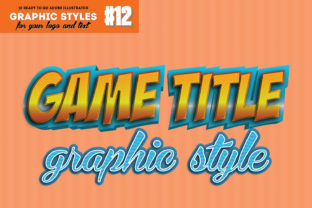
A key specification of this resource is the ease with which layers can be edited. In professional workflows, "easy to edit" translates to a logical organization of the document. A well-structured Game Vector Text Effect Fully Editable file will separate the base text, the extrusion paths, the highlight gradients, and the background elements into distinct groups. This allows a designer to isolate specific components—for instance, changing the metallic sheen on the letter faces without affecting the drop shadow.
Conversely, lower-quality alternatives often come as flattened objects or poorly grouped layers, forcing the user to use the "Expand Appearance" command repeatedly to gain control. This can lead to bloated file sizes and difficult-to-manage anchor points. The promise of this specific resource is that it avoids these pitfalls, offering a clean hierarchy that respects the non-destructive editing principles central to modern vector work. This makes it particularly suitable for teams where multiple designers may need to tweak the asset later in the project timeline.
Use Cases and Best-Fit Scenarios
Not every project benefits equally from a pre-styled vector text effect. Identifying the right context is crucial for maximizing the return on investment of your time. The Game Vector Text Effect Fully Editable is ideally suited for:
- Gaming Titles and UI Elements: Video games frequently require bold, stylized typography for main menus, achievement banners, and character names. The aggressive, dynamic styling inherent in these templates aligns perfectly with the genre's visual language.
- Event Marketing and Promotions: Esports tournaments, gaming conventions, and tech product launches often need high-energy graphics quickly. The ready-to-use nature of these files accelerates the production of posters, social media banners, and email headers.
- Merchandise Design: T-shirts, stickers, and patches for gaming communities require scalable vector art. Since the file includes an EPS source, it is print-ready for screen printing or embroidery digitization.
However, there are scenarios where this resource may not be the optimal choice. If a brand relies on minimalist aesthetics or corporate sans-serif typography, a heavy, stylized game effect would clash with the established identity. Additionally, if the project involves multilingual support with complex character sets not included in the default font pairing, the effort required to adapt the effect to every glyph might outweigh the benefits. In such cases, applying a simpler stroke or shadow effect to a standard typeface might be a more practical alternative.
Technical Specifications and Workflow Integration
From a technical standpoint, the inclusion of both an EPS source file and a JPG preview image streamlines the review process. The JPG allows stakeholders to visualize the concept immediately without needing specialized software, facilitating faster approval cycles. The EPS file ensures that once approved, the asset can be integrated into larger compositions without loss of fidelity.
The compatibility with Adobe Illustrator is a significant factor for most professional users. Since the file is made in Illustrator, it leverages the software's robust engine for handling complex paths and transparency. This ensures that when the text is enlarged for a large-format print job, no pixelation occurs. The ability to easily reduce or enlarge size is not just a marketing feature; it is a functional necessity for responsive design. Whether the text needs to fit on a smartphone notification or a stadium banner, the vector data scales proportionally, maintaining the integrity of the design.
Decision Factors: To Use or To Build?
Ultimately, the decision to utilize a Game Vector Text Effect Fully Editable depends on the specific constraints of the project. Consider the following factors before committing to this resource:
- Time Constraints: If the deadline is tight, the pre-built nature of this asset saves hours of rendering and path-finding work.
- Budget Limitations: For freelancers or small agencies operating on lean budgets, leveraging high-quality templates reduces costs compared to commissioning custom artwork.
- Customization Needs: If the desired look is close to the provided template but requires minor tweaks (color, font, slight shape adjustments), this is an excellent fit. If the requirements are vastly different, the learning curve to reverse-engineer the template may be too steep.
- Scalability Requirements: If the output must be printed at various sizes, the vector format is non-negotiable, making this resource superior to raster alternatives.
While the Game Vector Text Effect Fully Editable offers a powerful tool for rapid prototyping and production, it should be viewed as a component of a broader design strategy rather than a universal solution. By understanding its strengths in scalability and editability, alongside its limitations regarding stylistic rigidity, designers can make informed choices that balance efficiency with creative excellence. For those navigating the intersection of speed and quality in graphic design, this resource provides a reliable foundation upon which to build compelling visual narratives.